
How to Minimise Business Downtime During an Office Move
How to Minimise Business Downtime During an Office Move: Hello Removals shares practical planning advice to protect productivity and streamline your relocation.
An office move can interrupt staff, technology, customer service and essential workflows long before the removal vehicle arrives. To minimise business downtime during an office move, continuity needs to shape the relocation plan from the outset—not be treated as a final-day concern. For businesses changing premises in London, Hello Removals publishes this guidance to help decision-makers coordinate the physical move with the work that must continue for employees, clients and suppliers.
The aim is not necessarily to make every part of the move invisible. It is to identify where interruption would be most costly, then sequence people, equipment, access and communications so the business can recover quickly. A well-planned commercial move gives each team clarity about what happens before, during and immediately after relocation.
Why office moves cause business downtime
Downtime rarely comes from one issue alone. A delayed key collection, an unavailable lift, unlabelled crates, disconnected phones or a missing power lead can each slow a department. When several small problems happen at once, staff may be unable to work, clients may struggle to reach the right person and managers can spend moving day resolving preventable questions.
The operational risk is usually highest where the move affects functions that depend on one another. For example, a customer-facing team may need laptops, internet access, telephony, shared files and a usable workspace before it can respond normally. Finance, fulfilment, reception, technical teams and leadership may have different dependencies. Moving furniture successfully is important, but it does not by itself restore business operations.
Business continuity during an office move therefore requires two connected plans: one for moving the workplace and another for keeping priority activities available or restoring them in a defined order. That distinction helps a project lead make sound choices about timing, staffing, packing and removal support.
Build the move plan around critical business operations
Start with a named move coordinator who can bring together department leads, IT contacts, building management, suppliers and the removal team. This person does not need to perform every task; their role is to maintain the office relocation schedule, confirm decisions and flag conflicts before they become moving-day delays. For broader preparation alongside this article, our guide on planning a successful office move can help structure the project work.
A useful plan records the owner, deadline, dependency and fallback for every critical activity. It should cover the old office, the new office and the period in between. Keep it practical: a long document that is not understood by the people doing the work will not protect operations.
Identify the operations that must stay running
List the products, services and internal functions that cannot be paused, or can only be paused briefly. Then identify the people, systems, equipment, information, premises access and utilities each one needs. This is a focused business impact exercise rather than an attempt to document every office task.
Useful questions include:
- Which client commitments, deadlines or response channels fall during the move period?
- Which roles need secure access to data, phones or specialist equipment?
- What would prevent the business from taking payments, supporting customers or managing urgent work?
- Which suppliers, service providers or internal decision-makers need notice?
- Could a team work remotely or from a temporary location if the new office is not ready?
Risks may include loss of premises access, late utilities, incomplete fit-out, unavailable internet, misplaced equipment or an employee not receiving the latest instructions. Assign an owner and a response for each meaningful risk. Westminster City Council’s business continuity planning guidance similarly emphasises identifying critical activities and resources, assessing interruption risks and allocating clear responsibilities.
Where the scope is complex, professional coordination can make the physical relocation easier to align with the operating plan. Hello Removals’ London office removal service is relevant when you need to discuss practical sequencing, packing, transport and set-up requirements with a removal provider.
Choose the least disruptive timing and relocation approach
The shortest move is not always the least disruptive move. A single-stage weekend relocation may suit a compact office if building access, IT activation and furniture installation are ready. It concentrates disruption into one window, but leaves little room to correct a delay before staff return. A phased office relocation can keep priority functions working while teams move in stages, although it demands more coordination and may temporarily split colleagues, documents and equipment across sites.
Out-of-hours work can reduce disruption to normal trading, but only if the building permits it and responsible people are available for handover. Consider client commitments, payroll cycles, seasonal workload, public transport for staff, lift restrictions and the time needed to test systems. Avoid choosing a date based solely on vehicle availability.
Build realistic buffers around key collection, access, loading, transit, unloading, installation and technology testing. The likely duration depends on office size, distance, access, packing status and specialist items; see our explanation of how long an office relocation can take when setting expectations. The best timetable protects the functions that matter most, rather than promising an unrealistically fast restart.

HELLO REMOVALS
Why Choose Us? Your Move, Our Priority
- Experienced & Professional Team
- Comprehensive Service
- Local & Long-Distance Experts
- Stress-Free Moving
- Reliable & Transparent Pricing
Prepare staff, clients and suppliers before moving day
Moving offices without disrupting staff begins with timely, specific communication. Employees need more than a new address: they need to know what to pack, what stays in place, when they lose access to their usual desk and where to report after the move. Managers need a route for escalating exceptions, such as urgent files, accessibility needs or equipment that must travel with a particular employee.
Set responsibilities, packing instructions and deadlines
Create a simple department-by-department schedule. Set cut-off times for personal packing, archive decisions, IT collection and final desk clearance. Make clear who approves disposal, who holds keys, who escorts contractors and who signs off each area. A move coordinator should also distinguish priority crates from items that can wait until after reopening.
Give staff a clear labelling method that states the destination area, department, owner and priority where relevant. Consistent labels reduce searching at the new office and stop a high-priority item being placed in general storage. For practical preparation detail, use these office packing tips for a smooth relocation alongside your own internal instructions.
Ask teams not to pack shared equipment, paper records or technical items without confirmation from the responsible owner. That protects essential workflows and avoids a situation where a needed item is sealed in a crate that has already been loaded.
Communicate temporary arrangements and continuity information
Tell clients, suppliers and service partners only what they need to know, but give enough notice for them to use the correct contact route. This may include a brief period of reduced availability, an alternative phone number, a revised delivery point or a planned time for non-urgent responses. Reception, account managers and customer support teams should have aligned wording so information is consistent.
Internally, share the move-day timetable, new-office arrival instructions, emergency contacts and any remote-working arrangements in one easy-to-find place. Remind staff not to assume that a desk, meeting room or printer will be available immediately on arrival. Clear expectations help managers protect productivity while the workplace is being brought back into use.
Protect IT, communications and essential workplace systems
Technology is often the critical path in an office move. Even when devices arrive promptly, the business may not be operational until internet, phones, identity access, printers, meeting-room systems and shared data services are working. The removal plan should therefore follow the technology plan, not compete with it.
Coordinate internet, phones, devices, servers, data, backups and reconnection
Ask the internal IT team, managed provider or relevant supplier to define what must happen before equipment is disconnected, how it will be transported and who will reconnect and test it. Confirm the new-office installation date for internet and telephone services well in advance, including any building permissions or landlord requirements. Do not assume a service can be activated simply because the premises has power.
Record the location and ownership of critical equipment, cables, chargers, access cards and network hardware. Back up important data according to the organisation’s established procedures before the move. If servers, specialist devices or confidential material are involved, obtain handling and transport instructions from the appropriate technical or security lead rather than treating them as standard office contents.
Consider interim options for priority staff, such as secure remote access, pre-configured devices or temporary call handling, where suitable for the business. These arrangements should be agreed with the responsible provider and tested beforehand. Their purpose is to preserve essential work if the new-office setup takes longer than planned.
Use a first-day technology and connectivity check
Before announcing a full return to normal operations, test the systems people actually use. A concise check should cover:
- internet access at priority workstations and any agreed remote-working route;
- inbound and outbound calls, voicemail and customer-facing contact details;
- access to essential applications, shared files and approved printing;
- power, charging and safe cable routing at desks and meeting spaces;
- video meetings or other customer-critical communication tools; and
- the escalation route if a fault is found.
Test with representative users from the departments that have the most urgent needs. A network status light alone does not confirm that a customer service team, finance function or operations desk can perform its work.
Make packing, labelling and furniture preparation support a quick restart
Packing is not just a transport task. It determines whether staff can find what they need and whether the new workplace can be set up in the right order. Department-based packing, clear floor plans and priority labels enable the removal crew and on-site coordinators to direct items to the correct destination rather than creating a large sorting exercise after arrival.
Organise department-based labels, priority items and equipment protection
Use a consistent numbering or colour system linked to the new-office floor plan. Mark each crate with its destination, contents category and whether it is needed on day one. Keep a separate inventory for equipment that is operationally important or assigned to named people. Where appropriate, employees can carry essential personal work items themselves, provided this is coordinated and does not compromise security.
Protect screens, computers and other equipment using suitable materials and handling instructions. Keep cables with the relevant device only where the IT lead approves that approach; otherwise, package and identify them according to the reconnection plan. Avoid overfilling crates or using vague labels such as “miscellaneous”, which transfer uncertainty directly into reopening day.
Plan furniture dismantling, installation and specialist handling where relevant
Confirm which desks, storage units, meeting tables and reception furniture will move, which will be replaced and what needs dismantling. Check that the new layout allows safe access and that furniture can be placed without blocking technology work or emergency routes. Our office furniture removal and installation guide explains the preparation questions that commonly affect this stage.
Some workplaces also have unusual items, such as a piano in a reception or event space, that need separate assessment rather than being added casually to the general load. In that situation, specialist piano removal support in London may be appropriate. It is not a requirement for ordinary office furniture, but identifying exceptional items early prevents last-minute changes to the move plan.
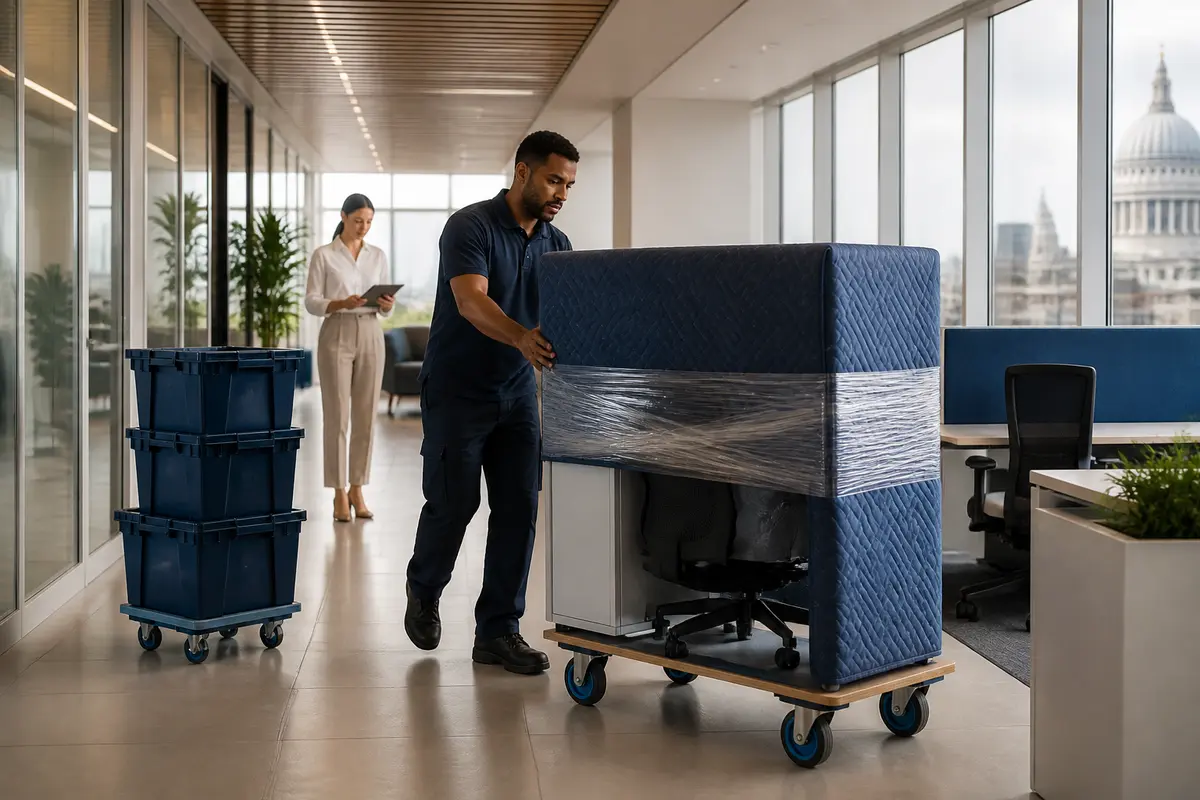
Coordinate the removal team, buildings and move-day logistics
A capable removal team can only work efficiently when the route, access conditions and sequence are clear. The move coordinator should brief the team on priority areas, destination floors, items requiring particular care and the people authorised to make decisions. That reduces waiting time and avoids unloading items into spaces that are not ready.
Confirm access, loading, lifts, parking, keys, floor plans and building rules
Speak with building management at both sites about loading-bay bookings, lift use, security procedures, parking, noise restrictions, insurance documentation requirements and permitted working hours. Confirm who will provide keys, passes and access codes, and arrange a contact who can resolve an access issue promptly. A floor plan with labelled zones gives the team a practical unloading map.
For London moves, traffic, restricted access and building schedules can influence vehicle timing as much as the distance between offices. If your move requires local removal support in Wimbledon, for example, the same principle applies: match transport and arrival timing to the building’s approved access window rather than relying on a general journey estimate.
Brief the team on any special handling, confidential materials, fragile equipment and items that must be delivered first. Businesses arranging support through Islington should provide the same information before moving day, including destination layout and the authority for on-site decisions.
Sequence the move around critical work areas and reduce waiting time
Load and unload in an order that supports reopening. Reception, IT equipment, priority operational teams and their core furniture may need to be positioned before archive storage or low-priority items. The right sequence depends on the business: a client-service operation may prioritise phones and workstations, while another organisation may need a secure records area or specialist workspace first.
Use short handovers at key points: when the old office is cleared, when the vehicle departs, when the new office is opened and when priority areas are in place. Each handover should confirm what has been completed, what remains and whether a contingency action is needed. This keeps decisions moving without assuming that every task went exactly as planned.
Prepare contingencies and a reopening checklist
A contingency plan does not predict failure; it gives the business a controlled response if an expected dependency is late or unavailable. Identify the decisions that cannot wait, the people authorised to make them and the temporary arrangements that protect priority work. Review the plan shortly before the move, because staff availability, building access and supplier dates can change.
Protect priority functions if delays occur
Decide in advance what happens if the new office cannot be fully used on time. Options may include temporary remote working, a limited team at an alternative workspace, prioritised delivery of certain equipment or a temporary client contact arrangement. The appropriate option depends on security, technology, contractual commitments and the nature of the work, so involve the responsible internal leads and providers.
Keep an escalation list with building contacts, IT support, key suppliers, senior decision-makers and the removal coordinator. Agree how staff will receive updates and who may communicate externally. This prevents conflicting messages when the business is under pressure.
Verify access, connectivity, equipment, safety, supplies and communications before full reopening
A reopening checklist turns the final stage of the office relocation into a deliberate handover rather than a hopeful assumption. Check the following before asking all teams to resume normal work:
- authorised staff can enter the premises and use required passes or keys;
- priority desks, furniture and equipment are in their planned locations;
- internet, phones and essential systems have been tested by relevant users;
- critical documents, equipment and supplies can be located quickly;
- work areas are safe, clear and suitable for use, with concerns raised to the appropriate building or safety contact;
- clients and suppliers have the correct contact and delivery information; and
- unresolved items have an owner, timescale and escalation route.
Capture issues while they are fresh, then update the office move business continuity plan for any remaining recovery actions. A short review after reopening can also improve future site changes, even if the current move is complete.
Final checklist for a lower-disruption office move
To minimise business downtime during an office move, make continuity the organising principle. Identify the work that cannot stop, appoint people to own critical actions, choose a realistic relocation approach, prepare staff and external contacts, and coordinate technology before the removal date. Then use clear labels, building access arrangements, move-day sequencing and first-day testing to turn a new premises into a functioning workplace.
The most effective plan is tailored to your operations rather than copied from another business. A small office with cloud-based systems may be able to relocate in one short window; a larger workplace with multiple departments, client-facing services or specialist equipment may benefit from a phased approach and more detailed contingencies. For additional context on preparing a London relocation, see our complete guide to office removals in London.
When the physical move needs to be coordinated around a practical operational plan, Hello Removals can be part of that conversation. Explore our office removals in London support to consider how removal scheduling, packing and on-site coordination can fit your business’s requirements without losing sight of the functions that need to restart first.
Ready to Make Your Move Simple and Stress-Free?
Home Removals – Office Moves – Long-Distance Moving
Planning a move? Let Hello Removals take care of the hard work with a reliable, professional moving service tailored to your needs. Contact our team today for friendly advice and a free, no-obligation quote.